
Network
- CIM
- CGMES
- Network topology
- Substations
- Lines
- Transformers
- Bays
- Connectivity
NeuroCluster Labs · Energy & grid research
Grid Foundation Models
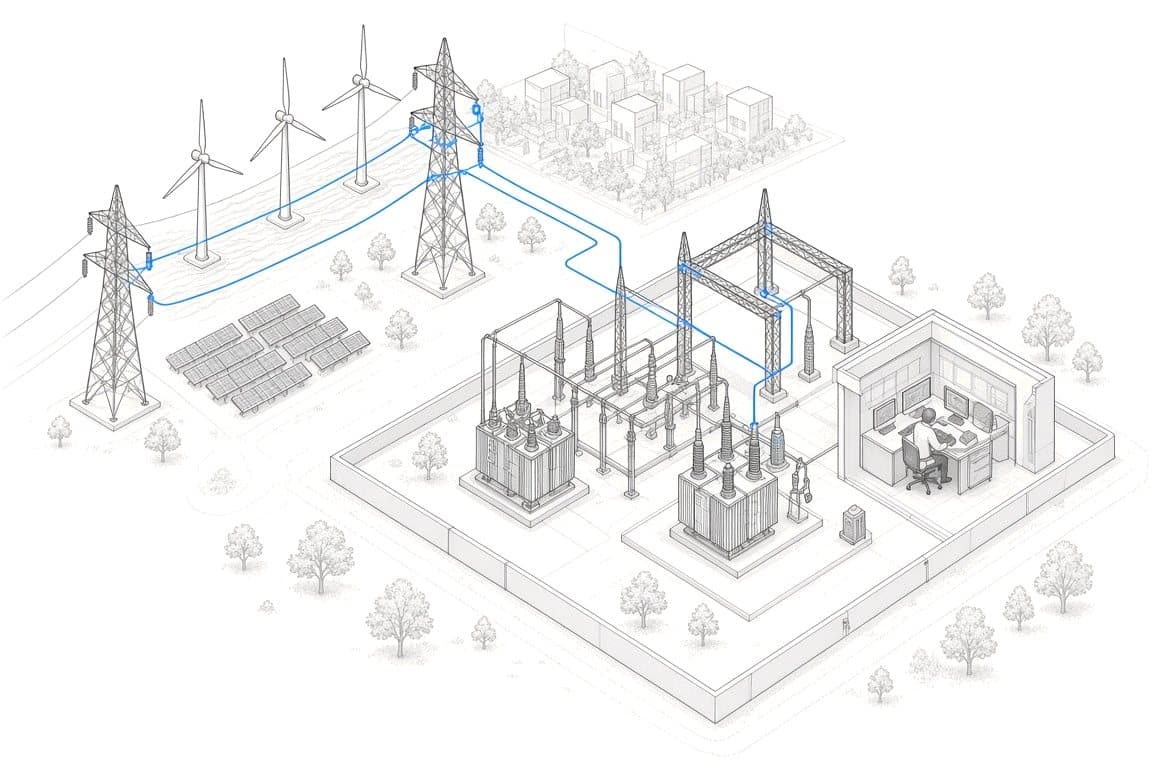
Research programme·In developmentEurope's electricity system is becoming more interconnected, distributed and dynamic.
The intelligence operating the grid must evolve with it.
NeuroCluster Labs is researching sovereign foundation models designed specifically for Transmission System Operators, Distribution System Operators and the European power system.
Why grid foundation models
Today's AI models primarily learn relationships between words and images.
AssetthenTopologythenElectrical statethenWeatherthenConstraintthenForecastthenInterventionthenOutcome
That requires more than an LLM.
It requires models capable of understanding the grid as a changing physical network.
What the model can observe
The research model family
Try a question
Components active
7 / 7
Illustrative routing. The programme researches how a grid question can activate only the specialised components it needs.
Learns network structure, connectivity, asset relationships and topology.
Learns temporal behaviour from measurements, events, demand, generation and weather.
Understands visual observations of grid infrastructure and relates defects to the correct asset.
Understands procedures, engineering documents, work orders, incidents and technical knowledge.
Combines grid context with calculations, rules, simulations and evidence.
Interacts with approved tools and enterprise applications within defined authority boundaries.
Research into models that represent grid state and evaluate possible future states following operational interventions.
Shared grid representation
Not isolated AI applications — together, a foundation intelligence layer for the grid.
The grid representation
Fragmented systems
SCADA / PMUplusCIM / CGMESplusGISplusSAP / EAMplusWeatherplusInspectionplusMarketplusDocuments
Grid ontology
Grid state
Grid models
Graph · Time series · Vision · Language · Reasoning
Operational intelligence
Understand · Predict · Simulate · Recommend
Operator authority
Review · Approve · Reject · Escalate
Controlled action
Operations
Potential research and application areas include:
Combine network state, events, topology and operational context.
Understand whether multiple signals represent independent events or one developing system situation.
Connect forecasts, topology, weather and network constraints.
Assist engineers analysing potential system states and validated contingencies.
Bring relevant topology, assets, procedures and operational evidence together during restoration planning.
Retrieve and structure evidence without removing operator authority.
Planning
Short-, medium- and long-term grid demand.
Weather-aware generation expectations.
Understand where available capacity exists and why.
Support assessment of new generation, storage and demand.
Compare future scenarios and investment options.
Analyse interconnected network and system context.
Asset intelligence
Asset condition should not be a single field in an asset-management system.
It can be constructed from:
= Composed
Asset condition estimate
Composed from every input, and traceable back to each of them.
This enables research into
Dynamic capacity
Weather, asset condition, network topology and system state can influence available capacity.
Grid foundation models can support research into:
WeatherthenConductorthenThermal statethenAvailable capacity
Network statethenConstraintsthenAlternativesthenSimulated impact
DemandthenGenerationthenStorage
Flexibility evaluated against network conditions.
Predict where and when system constraints are likely to emerge.
AI.grids and the European ecosystem
Europe is now developing sovereign AI foundation models specifically for power-system operations through initiatives including AI.grids.
NeuroCluster Labs supports the same direction: open European research, interoperable datasets, sovereign compute and practical validation with grid operators.
Our focus is particularly on the layer needed to bring those capabilities into operational environments:
Grid ontologyplusModel orchestrationplusEnterprise contextplusPolicyplusEvidenceplusHuman authorityplusControlled action
The goal is interoperability, not another isolated AI stack.
European grid foundation models
Open European research
NeuroCluster grid model layer
NeuroCluster Labs
NeuroCluster platform
Operational intelligence
GridSight
For the energy market
TSO / DSO systems
The operator's estate
AI.grids is an independent European initiative. Naming it describes the ecosystem this programme is designed for; it does not imply participation or endorsement.
Safe by design
The programme separates:
Models can retrieve and interpret authorised information.
Requires
Models can produce forecasts, analysis and proposed actions together with evidence and uncertainty.
Requires
Actions require explicitly assigned authority and policy.
Requires
For operationally critical decisions, human authority remains part of the system architecture.
Model evaluation
Generic language benchmarks tell us very little about operational grid capability. NeuroCluster Labs therefore proposes grid-specific evaluation across areas including:
Can the model correctly reconstruct and reason about network connectivity?
Can it connect events occurring across different timescales?
Can it identify which system constraint matters to a decision?
Can it connect observations and maintenance history to the correct physical asset?
How accurate and calibrated are predictions?
Do recommendations remain consistent with validated engineering tools?
Can every material conclusion be traced to its evidence?
Does the system remain within its assigned operational permissions?
The public benchmark programme these evaluation areas feed into. Industrial Intelligence Benchmark
Sovereign grid AI
Designed for deployment across:
01
02
03
04
05
Operational data remains within the boundaries defined by the system operator.
The relationship with GridSight
NeuroCluster Labs
Develops and evaluates grid intelligence.
Grid Foundation Models
Understand network, time, assets, vision and technical knowledge.
NeuroCluster
Adds ontology, agents, governance and evidence.
GridSight
Turns intelligence into real TSO and DSO applications.
ResearchthenIntelligencethenDecisionthenControlled action
GridSight — for the energy marketPartners can contribute through datasets, synthetic environments, model research, compute, evaluation or operational use cases.
We are looking to collaborate with