
Sparse expert architectures
Activate specialised capacity only when it is needed.
NeuroCluster Labs · Research programme
European Industrial Intelligence
Research programme·In developmentGeneral-purpose AI understands language. Industrial intelligence must understand assets, networks, processes, time, physics, constraints, risk and operational authority.
NeuroCluster Labs is researching a new class of sovereign AI models designed for Europe's physical and critical industries.
Not another chatbot. Models that learn how industrial systems behave.
The research thesis
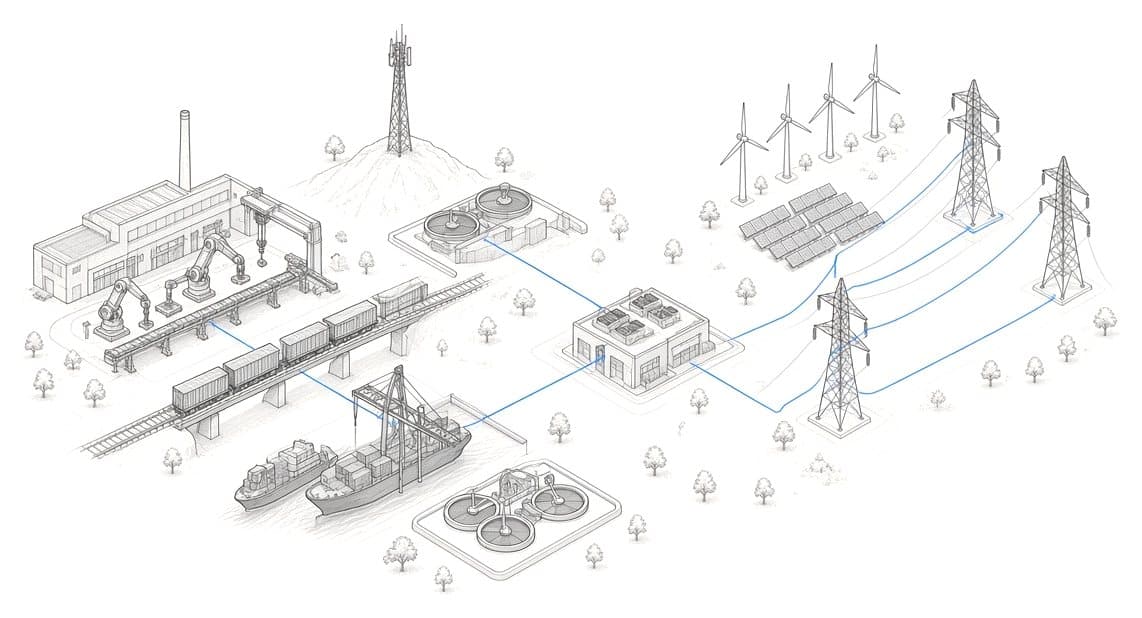
A transmission grid is not a collection of documents. Neither is a factory, railway network, water system, telecommunications network or logistics operation.
They are interconnected systems whose state changes continuously. Industrial AI therefore needs to reason across multiple forms of information at the same time:
Forms of industrial information
European Industrial Intelligence is our research programme to bring these representations together.
From language models to industrial models
The objective is not to make every modality look like text.
It is to create models that develop a shared representation of the industrial system they are reasoning about.
The model system
We are researching a modular model architecture rather than assuming one enormous model should solve every problem.
Try a question
Components active
6 / 6
Illustrative routing. The long-term research direction is a mixture-of-experts model in which each question activates only the specialised capacity it needs.
Reasoning over technical knowledge, operational situations and evidence.
Models for telemetry, events, forecasting and temporal relationships.
Representation learning for assets, networks, dependencies and topology.
Multimodal models for inspections, defects and physical infrastructure.
Models trained to interact safely with tools, simulations and enterprise systems.
Research into shared representations of system state and the potential consequences of interventions.
European Industrial Intelligence Model
Together, these components form the model programme.
Sector layers such as Grid Foundation Models specialise these components for one industry. Grid Foundation Models
Research architecture
Eight stages, from what the system observes to what it learns from the outcome. Select a stage to see what it covers.
↺ Measured outcomes feed the next cycle
01 — OBSERVE
Take in the signals an industrial system already produces, wherever they live.
A different training strategy
The programme investigates training and adaptation using a combination of sources — each with its own route into the model.
Open knowledge
Public and structured
Generated
Safe to create at scale
Operational
Under controlled access
Controlled European environment
Customer-controlled private adaptation
Inside the organisation's own boundary. Operational knowledge stays with the organisation.
Sensitive operational data does not need to become part of a central public model.
Models can be trained, adapted and evaluated inside controlled European environments.
Architectural principles
Frontier capability does not have to mean maximum parameter count. Our research explores:
Activate specialised capacity only when it is needed.
Specialised model components for energy, industrial systems, infrastructure and engineering.
Combine text, graph, time-series, image and geospatial information.
Train reasoning against simulations, calculations, constraints and measurable outcomes where possible.
Generate safe training environments for rare and critical operational situations.
Use validated solvers, simulators, databases and engineering applications instead of asking the language model to approximate everything itself.
Design models for European cloud, dedicated infrastructure, on-premises and isolated environments.
Industries
Networks, constraints, generation, demand, assets and system operation.
Grid Foundation ModelsProduction, equipment, quality, supply chains and maintenance.
Networks, vehicles, routes, capacity and disruptions.
Networks, services, incidents, capacity and infrastructure.
Physical networks, environmental state, forecasting and resilience.
Mission-critical information environments with controlled authority boundaries.
Cross-domain dependencies and infrastructure resilience.
Sovereign by architecture
The research programme is designed around:
Training and inference deployable on European infrastructure.
Data location and access remain explicit.
No critical application should depend on a single proprietary model.
Capabilities are benchmarked rather than implied.
Models can move between compatible sovereign infrastructures.
Organisations retain control over their operational knowledge.
NeuroCluster Labs
A model by itself cannot safely operate critical infrastructure. NeuroCluster connects models to the additional layers required for production.
Model capability
Operational authority
This separates model capability from operational authority.
A model can understand. NeuroCluster determines what it is allowed to do.
NeuroCluster Labs
Research
NeuroCluster platform
Production
Industrial applications
Consumption
We are looking to collaborate with European industrial organisations, research institutes, universities, infrastructure operators, AI Factories and technology partners.